Can a general-purpose frontier model act as a robot policy with no robot-specific finetuning? We test GPT-6 Astra in three roles on RoboLab-120: generating actions directly, running as an agent in a persistent coding session, and monitoring a separate robot foundation model. The agentic setup reaches 74.8% success but at far higher token cost, and direct inference is slow at about 18.6 seconds per call.
ARC improves robot foundation models by grounding reasoning in the robot's next action and its expected effects. It automatically labels existing demonstrations with reasoning traces and adapts pretrained policies to use them, achieving state-of-the-art results on RoboLab-120 and MolmoSpaces without new robot demonstrations or foundation-scale training.
RoboLab is a high-fidelity simulation platform for evaluating robot policies trained on real-world data. Fast scene and task generation keeps the benchmark from saturating, and the 120-task suite separately measures visual, relational, and procedural generalization.
Cosmos 3 is an open omnimodal world model that unifies reasoning, generation, simulation, and robot action across text, images, video, audio, and actions in a single model.
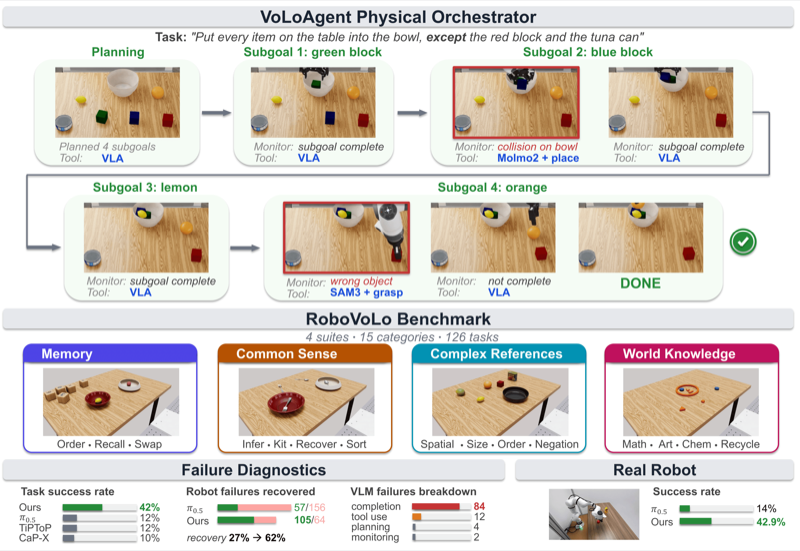
VoLo frames long-horizon manipulation as physical orchestration: a VLM agent plans, monitors, and recovers by steering a VLA or world-action model as an interruptible tool alongside perception and grasp primitives. The accompanying RoboVoLo benchmark covers 126 tasks with failure-mode diagnostics.
AdaVoMP predicts dense, spatially varying Young's modulus, Poisson's ratio, and density for 3D objects. A sparse adaptive voxel structure with an autoregressive sparse transformer reaches far higher resolution than prior work while improving accuracy and memory efficiency.
VLA-0 turns a vision-language model into a robot policy by having it emit actions as plain text integers, with no changes to its vocabulary or architecture. It is the strongest model on LIBERO among those without large-scale robot pretraining and transfers to real SO-100 tasks.
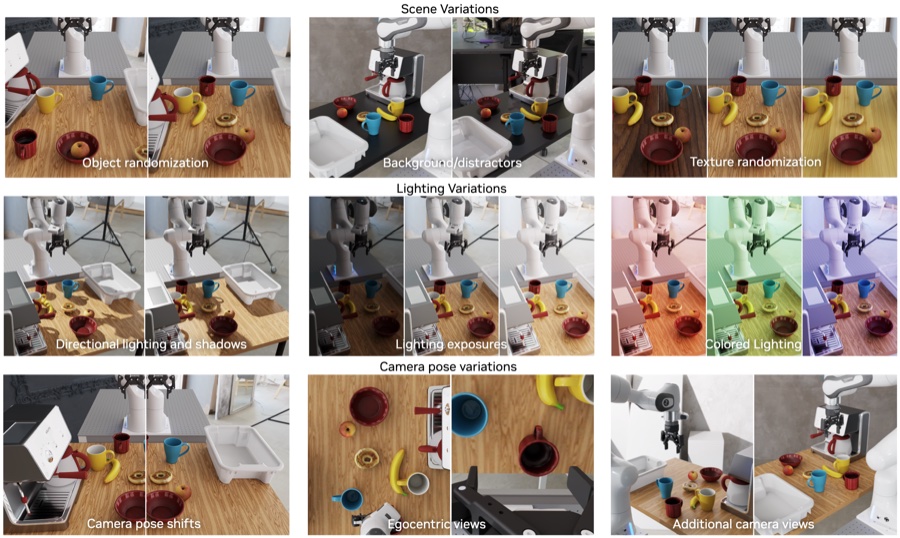
A position paper arguing that benchmarks for generalist manipulation policies should predict sim-to-real transfer. We propose high-fidelity visual simulation, graded difficulty and perturbation sweeps, and explicit measurement of how closely simulated rankings match real-world performance.
RoboArena evaluates generalist robot policies by having many independent evaluators run blinded head-to-head comparisons on tasks and environments of their choosing, then aggregating the results into a ranking. Across seven institutions and over 600 real-robot trials, it ranks policies more accurately than centralized evaluation.
ITPS lets a human steer a pretrained diffusion policy at inference time by biasing its sampling with point, sketch, or physical-correction inputs, with no fine-tuning. Stochastic sampling gives the best trade-off between following user intent and staying in-distribution.
Aim My Robot navigates a mobile robot to a centimeter-precise pose relative to any nearby object, rather than the meter-level tolerance of typical navigation stacks. It is trained entirely on photorealistic simulated data and transfers to real robots and unseen objects.
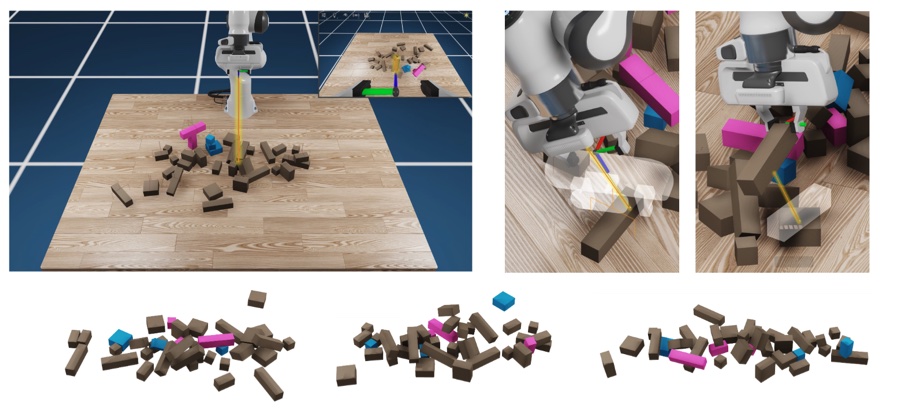
Instead of inferring operator intent in cluttered scenes, the operator points the gripper at the target to state the goal explicitly. In a 20-person study, participants preferred this approach, had fewer pick failures, and reported lower workload than with inference-based assistance.
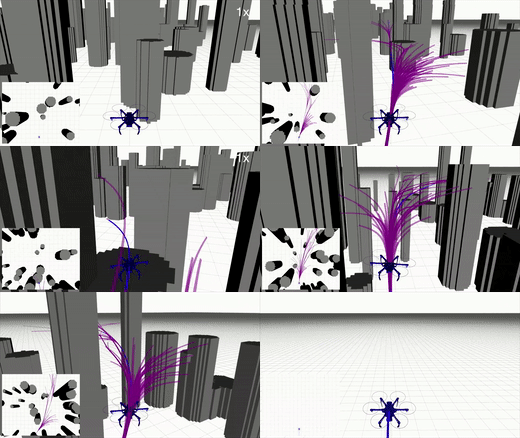
An assisted teleoperation method that grows a tree of motion primitives biased toward the operator's inferred intent, producing smooth, collision-free trajectories that stay aligned with the operator's input on a mobile robot.
A complete system for fast, agile multirotor flight using only onboard vision, combining teleoperation with real-time collision avoidance, demonstrated in cluttered indoor and outdoor environments.